Liftoff
June 1st, 2011
1680x1050 wallpaper
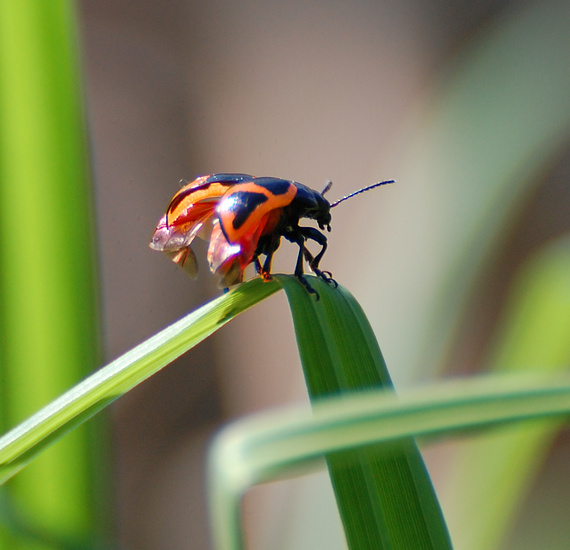
1680x1050 wallpaper

All For Show
May 31st, 2011
I was near the parking lot at Jack Pine Trail when I encountered this beautiful and fierce-looking insect:
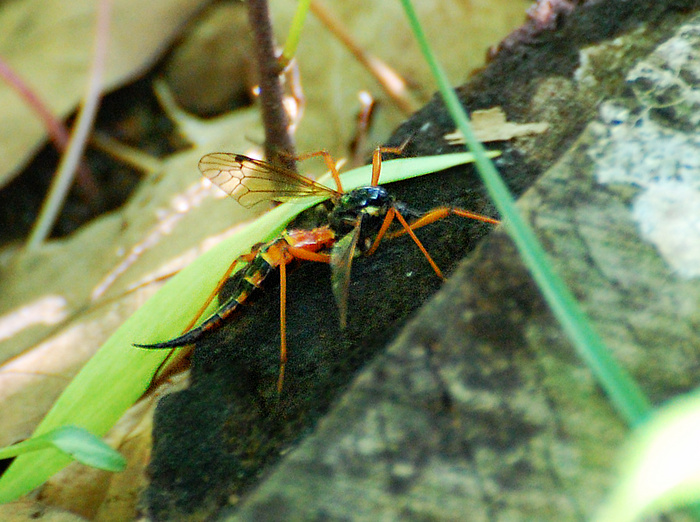
Keep in mind I don't have a macro lens. This isn't a magnification of some tiny mite. It was over an inch long. It was creeping on an old, lichen-encrusted stump and adjacent rock, and I went crazy trying to get a good, sharp and well-lit photo, firing the shutter repeatedly everytime it went into a patch of sunlight.
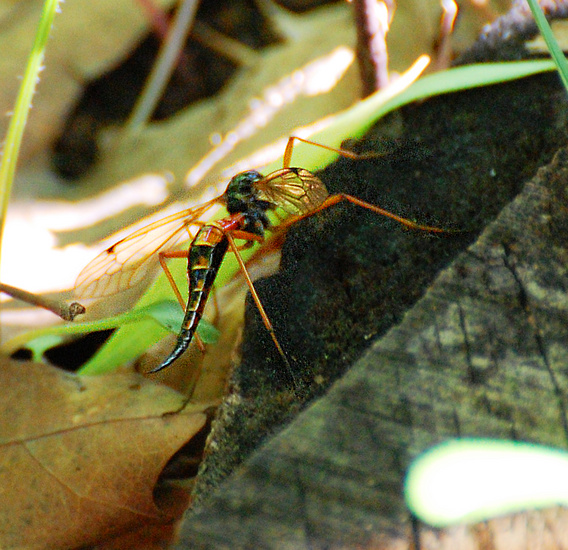
When it left the stump and flew towards me, I stood stock-still, because honestly, who wants to tangle with something that looks like that? I regret it now because my subject then flew off while I wasn't looking.
Come to find out (thanks to Christine Hanrahan, a local expert) it's a harmless cranefly! Genus ctenophora, likely ctenophora dorsalis, a wasp mimic. That long, pointed, upcurved tail, by which I feared getting stung, was nothing but an ovipositor. Which means it was a female, and given where she was and how she was behaving, I likely caught her in the process of laying eggs, or at least, searching for a place to lay eggs.
I never got quite the shot I wanted, so I hope to cross paths with this species again someday.
Common Yellowthroat at Jack Pine Trail
May 30th, 2011
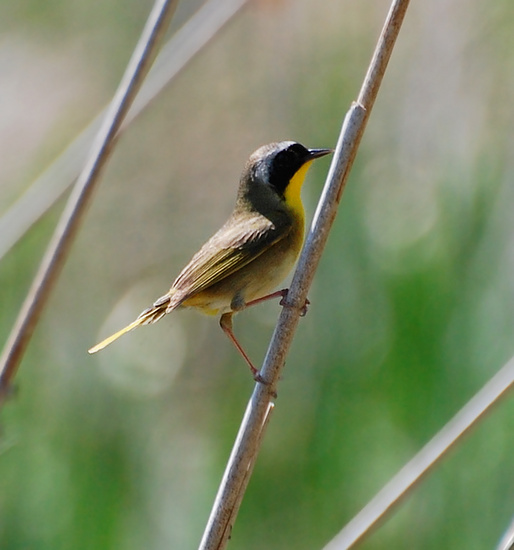
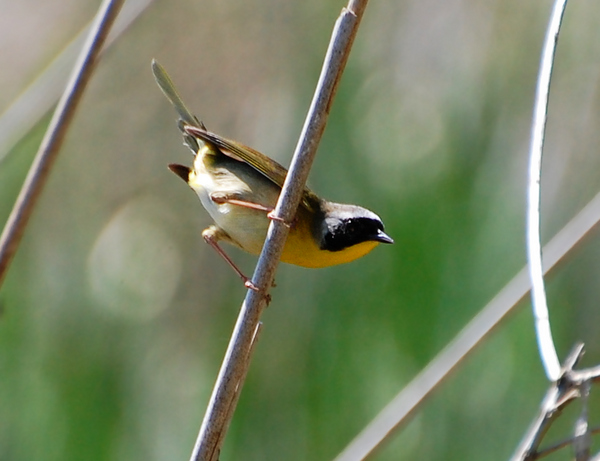
The Common Yellowthroat is a common breeding warbler in Ottawa's marshes and met meadows. Its habit of skulking in deep brush and tall cattails makes it difficult to observe. However, yellowthroats get quite curious about intruders into their territory, and are responsive to pishing. You can sometimes get good views as they hop around trying to figure out what you are and what you're up to.
Chestnut-Sided Warbler
May 11th, 2011

The striking Chestnut-Sided Warbler is a bird of young growth--old abandoned farmland, for instance, and other scrubby habitats. This one was in the fields south of the airport.
Spring Oriole
May 8th, 2011
Baltimore Orioles and Gray Catbirds are back.
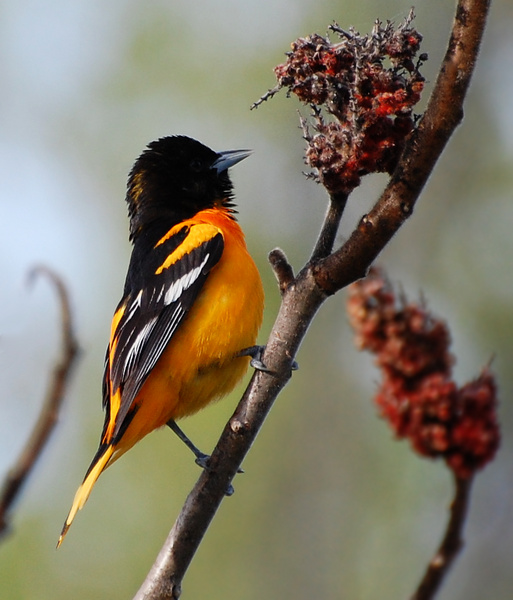
1680x1050 wallpaper

Fortissimo
May 7th, 2011
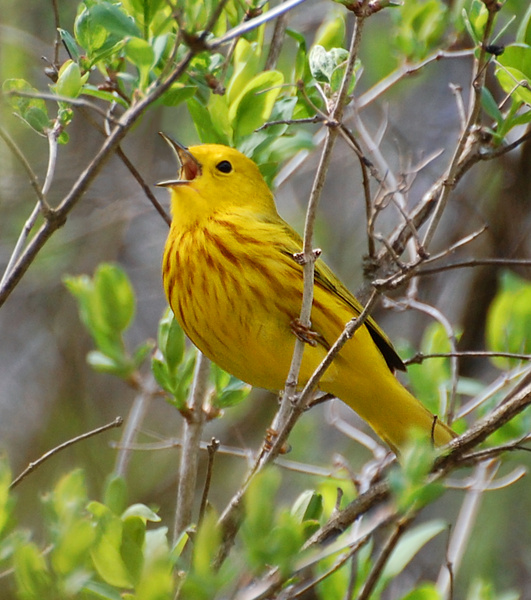
Mud Lake's breeding Yellow Warblers are back, and singing their hearts out!
Bufflehead
May 4th, 2011
This fellow swam by on the river while I was busily photographing the parula. It was my first opportunity to photograph a Bufflehead from anything like a reasonable distance, so I took it!
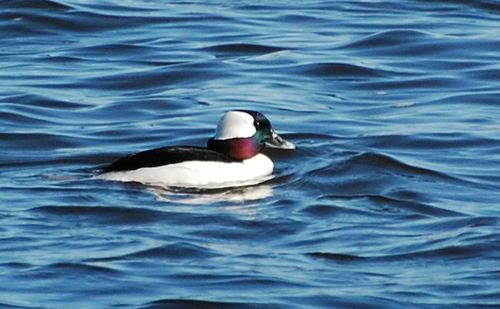
The Bufflehead is a very small diving duck, closely related to the goldeneyes. It is a primarily boreal species. Its small size is an adaptation to the size of its preferred nesting location: old Northern Flicker holes. As with Wood Ducks, the new ducklings will crawl out of the nest hole and jump, sometimes from many meters up, land on the forest floor and survive the fall (somehow!), and follow their mother to water.
The male Bufflehead's claim to fame is the beautiful rainbow irridescence of his head plumage, visible only in good light.
A bashful beauty
May 2nd, 2011

The Northern Parula is one of my favorite birds.
It's a tiny warbler, no bigger than a kinglet, with a bright yellow breast and, on the breeding male, some rusty banding across the throat. Its back usually looks grey, but if you see it close up and in just the right light, it turns a lovely shade of sky blue. (All blue birds are like that, to some extent--lighting-dependent, I mean. It's because the blue comes not from pigment, but from the way light refracts through specially-shaped feathers.)
Parulas are rather shy birds. It's not that they're particularly scared of humans, per se, just that their whole lifestyle seems designed around self-concealment. They don't fly much (except in migration), or hop out into the open much. They'll spend hours quietly creeping around in treetops hunting for crawling insects. Even when a parula sings (a song Roger Tory Peterson described as a buzzy tril "that climbs the scale and trips over at the top"), he often sings in mid-forage, not bothering to come out from behind his leafy cover.
The impression of shyness is completed by parula nesting habits. They require, in the south, woods festooned with spanish moss; here in the north, they use the similar Old Man's Beard lichen. Their nests are concealed within clumps of the moss.
So you might imagine they're tricky to photograph! I was at one for over an hour and never got my golden moment: the moment when the bird comes low, out in the open, in excellent light and well-posed, and I get in a shot in the millisecond I have before he hops back under cover. And it's not blurry. (With birds as hyperactive as most warblers, "not blurry" can be a challenge in itself.) Still, I got a few worth sharing.
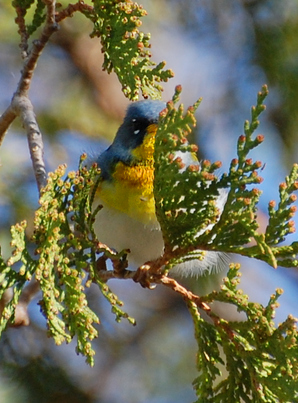
Did I mention, bashful? :-)
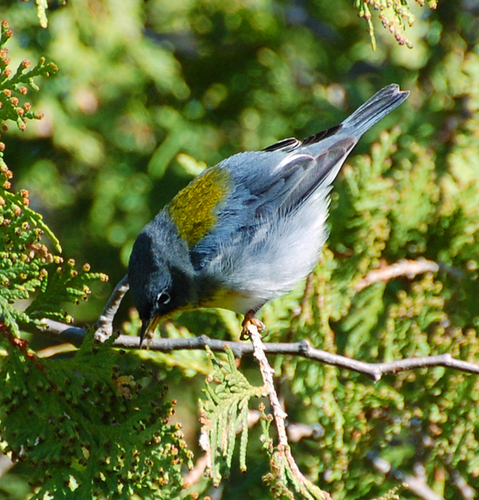
This photo shows another key field mark: a suffuse greenish-yellow patch on the middle of the back. It's particularly handy when identifying females.
The hills are alive with the sound of...
May 1st, 2011
birdsong!
I've now counted 52 species in migration--birds either returning to Ottawa, or passing through on their way further north. With warm weather, the dedicated insectivores are coming back. That means warblers!
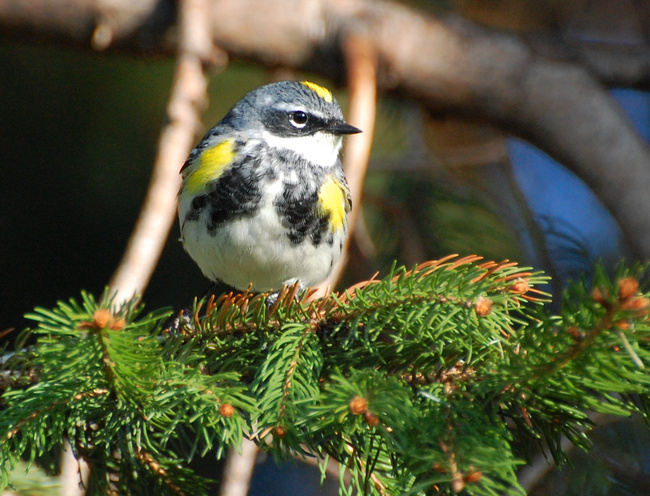
1680x1050 wallpaper
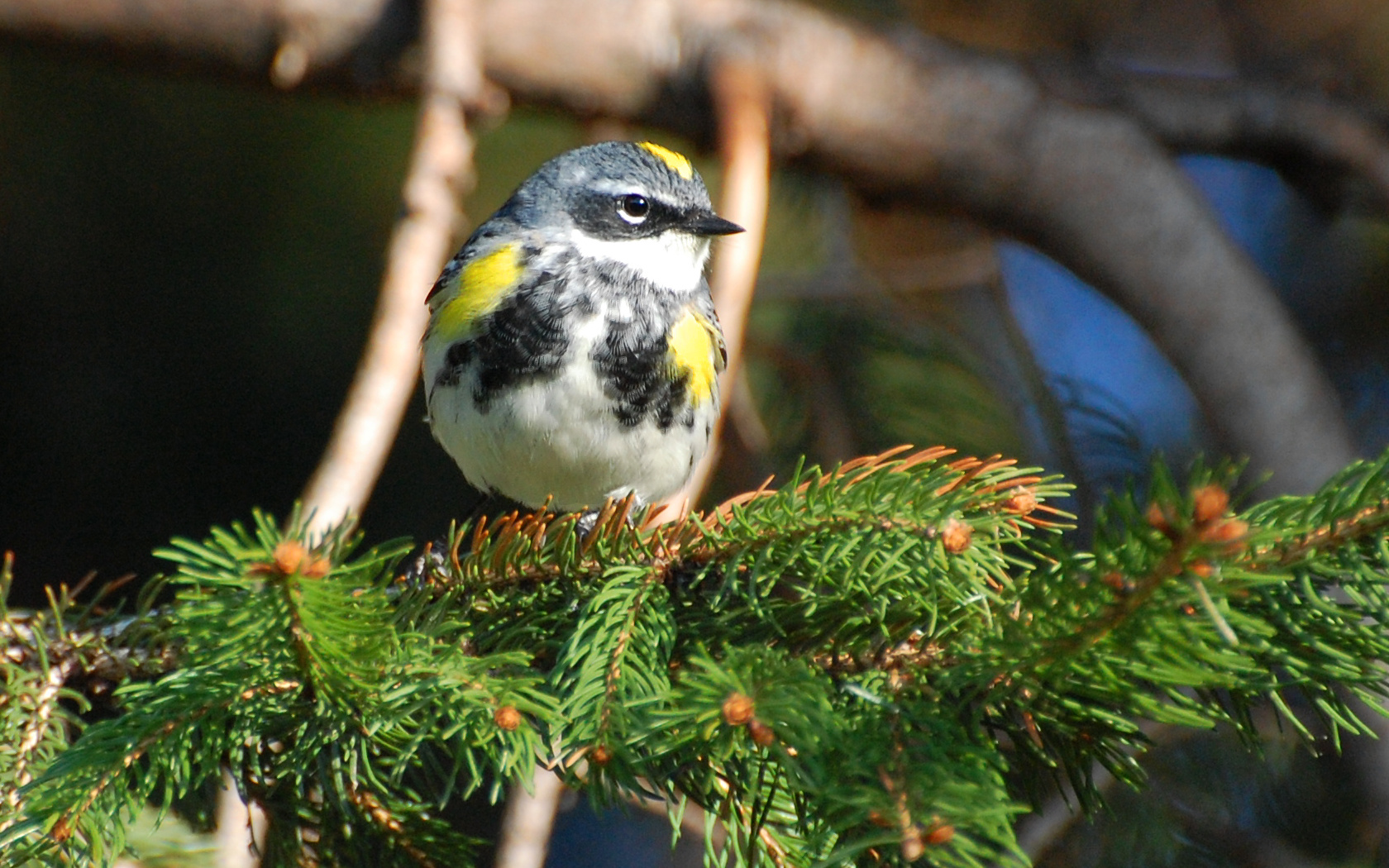
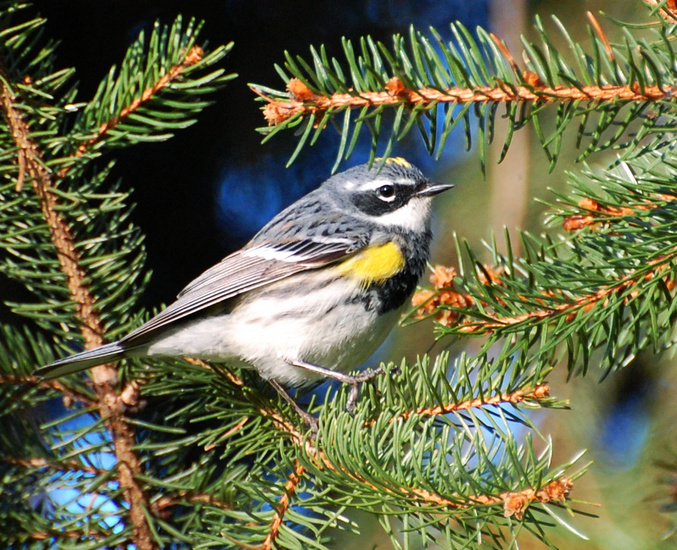
Have you ever seen something so teeming with little creatures, it's like the thing itself was alive? That's how it was yesterday morning, with three tall spruce trees at Mud Lake, and literally dozens of Yellow-Rumped Warblers packed into them. This species is an abundant breeder in the boreal forest, and thus an abundant migrant in spring and autumn. Birding becomes a matter of picking through the five hundred Yellow-Rumpeds to find the one interesting bird--the one who isn't a Yellow-Rumped but is one of the 20+ other warblers who occur in our area. But right now YRW's are still fresh and new and I'm enjoying them!
From AllAboutBirds:
Yellow-Rumped Warblers are perhaps the most versatile foragers of all warblers. They're the warbler you're most likely to see fluttering out from a tree to catch a flying insect, and they're also quick to switch over to eating berries in fall. Other places Yellow-Rumped Warblers have been spotted foraging include picking at insects on washed-up seaweed at the beach, skimming insects from the surface of rivers and the ocean, picking them out of spiderwebs, and grabbing them off piles of manure.
Spring is breaking out all over
April 10th, 2011
All of a sudden spring is here. Out in a sweatshirt, no jacket, with sleeves rolled up half the time. Buds on the trees and bushes. Mud Lake is now largely ice-free and new migrants are coming in one after the other! Killdeers and a Barn Swallow in the east end yesterday; Belted Kingfisher over the Rideau in the morning, all new. Today, my first Flicker of spring, and Tree Swallows swooping over Mud Lake and the Ottawa River, hawking the insects that are now emerging everywhere. Apparently someone saw ten (!) Black-Crowned Night Herons in a tree across the river, in the area where that species typically nests, but my binoculars weren't strong enough to pick them out.
I don't think of Mud Lake as a duck magnet in spring--migrant ducks usually prefer the nearby Ottawa River, which thaws earlier--but today the lake was the duckiest I've ever seen it in April, with small groups of Hooded Mergansers, Common Mergansers and Ring-Necked Ducks joining the resident waterfowl.
A Cooper's Hawk was making mating calls in the pine woods, suggesting that a pair of them will once again breed there this summer. I find it interesting that they and the raven pair nest so close to each other. Surely neither one is particularly comfortable with the other: a Cooper's Hawk would happily eat a raven nestling and a raven would just as happily eat a baby Cooper's Hawk!
Another week or so and the first Yellow-Rumped Warblers will start trickling in. Then, in May, their many cousins. I've made it my mission to get more warbler photos this spring.
( Migration 2011 )
|