Marsh Slinkers
May 23rd, 2014
Here in Ottawa we have an ostensibly common bird called a Virginia Rail. It took me over a year of trying to see one. And it has taken me over five years of trying to get a picture of one.
Rails are incredibly bashful. They spend their lives creeping, mouselike, through thick stands of cattail. Their bodies are laterally compressed to allow them to squeeze through narrow gaps between reeds. (Supposedly, they're where the phrase "skinny as a rail" comes from.) You never see them in flight. They don't flush when disturbed, they just slink away.
The trick, as it turns out, is sound. When you play back a recording of their mating call at the right time of year (spring, mainly), they just can't resist checking it out. And that is to thank for this:
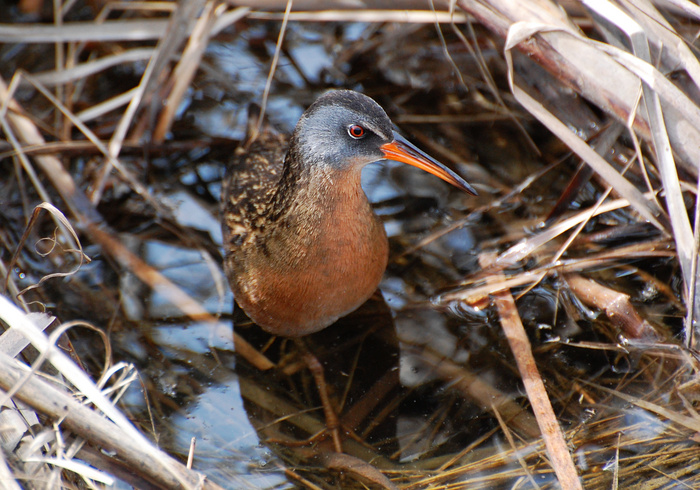
1680x1050 wallpaper
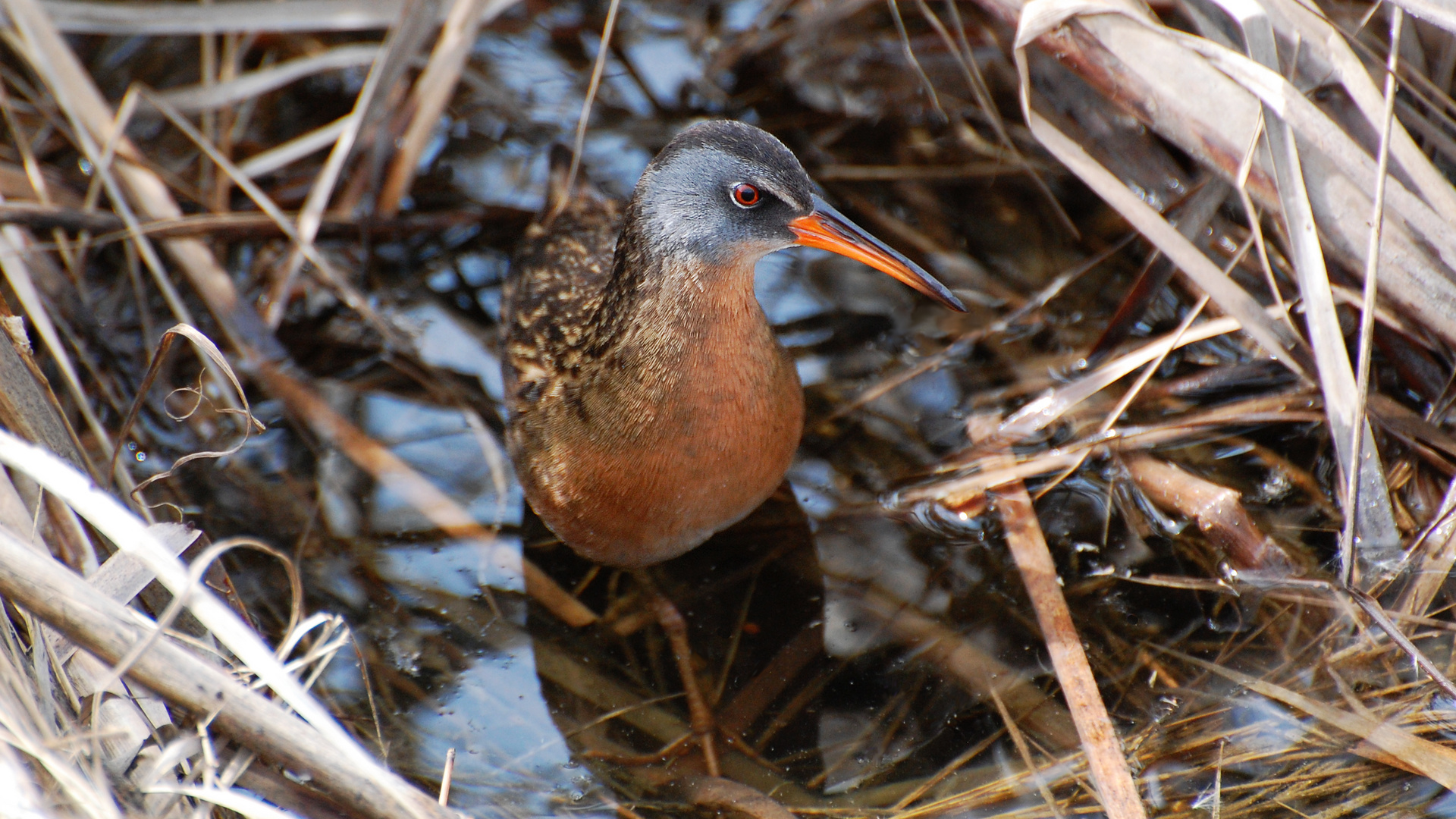
This handsome fellow came all the way out to the edge of the marsh for me. He and his mate had responded vociferously to my playback, and he emerged with the intent to send his (imaginary) rival packing. A car going by quickly sent him scurrying back into the reeds. Having had my one good look, I stopped playback. It's important to let the territorial male think he's "won" the exchange.
Look carefully in the water--you can see his toes splayed out. Rails are closely related to gallinules (such as the young Purple Gallinule I showed from the El Rey wetlands), and like them, have long spindly toes suited for walking on boggy ground.
It was only a few days later that I got my first picture of a Sora rail after five years of trying. Soras are the answer to the question, "could any birds be more impossible than Virginia Rails?" They're less common, and in my experience, even shier. I have read field guides claiming that Soras are bold and confiding (y'know, for rails) and will readily feed out in the open. I don't know what kind of cruel joke those field guides are trying to pull, but needless to say, that has not been my experience. Even Sora calls are a form of camouflage. Their most common spring vocalization is a plaintive "ker-wee?" that sounds just like a spring peeper.
(And neither Virginia Rail nor Sora can hold a candle to the famously impossible Yellow Rail. In Larry Neily's words, "to actually see one, you'll need a miracle." It is not yet on my lifelist.)
At the Nortel wetland, a Sora began to vocalize nonstop soon after I started playback. I stopped after a few rounds to avoid causing undue excitement, but the vocalizing continued. It was only a single individual calling this time, and I got the distinct impression that it was not an angry territorial sora, but an unmated sora hoping very much that it was about to get lucky. I thought sure this very excited rail would soon appear, but I must have sat there for at least fifteen minutes without so much as a glimpse--even a hint of movement--even though it sounded like it was ten feet away from me.
Just when I was about to come to the conclusion that I had gotten fooled by a frog, I saw it: a faint silhouette behind the reeds. For about five more minutes I watched the silhouette, its neck arching back with every "ker-wee." And then, at last, a curious face poked out of the tent of cattails.
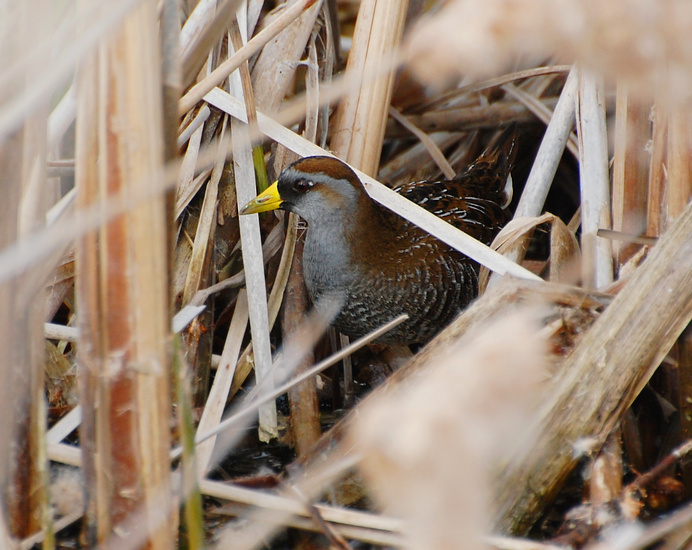
1680x1050 wallpaper

When I came back through almost an hour later, it was still vocalizing. Sorry to get your hopes up, fella. I hope a real opposite-sex-sora comes along soon.
Death Of A Camera
May 18th, 2014
The inevitable has happened. After years of faithful service, my camera has given up the ghost.
At least you can say it died doing what it loved. I was out at South March Conservation Forest today, getting a slew of photos of birds and flowers on an unseasonably frigid but beautiful morning. It was just after I had taken my best picture ever of a particularly gorgeous species of songbird that the shutter gave out.
So there will be those, and there will be more, since I've built up a backlog of unposted Ottawa pics while I've been blogging about Costa Rica. And then that will be all for awhile. Unless the repairs are cheaper than I expect, I'll be buying a new camera body, which probably won't happen until after Christmas.
Scenery for a change
May 17th, 2014
Pretty sunset in Kanata today.
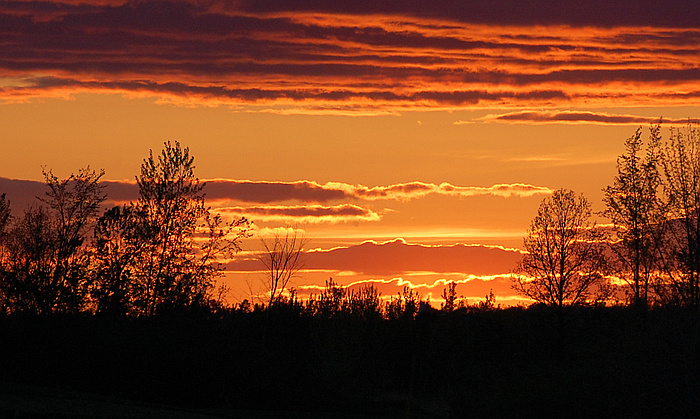
1680x1050 wallpaper

And all the rest...
May 16th, 2014
Some final photos from Costa Rica, followed by my triplist. The permanent home for pictures from this trip will be here.
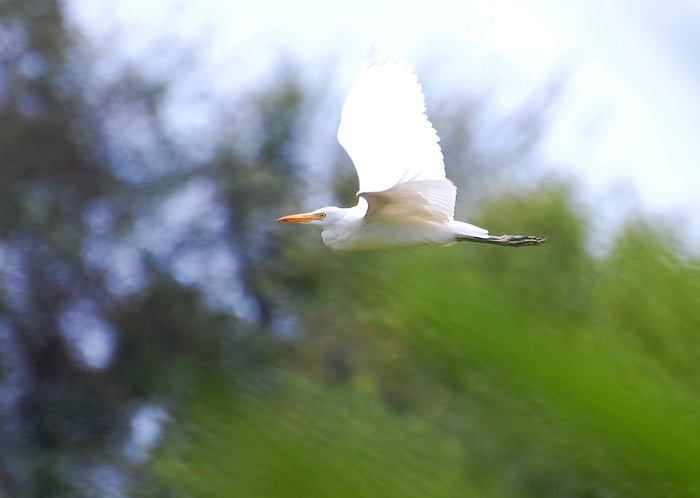
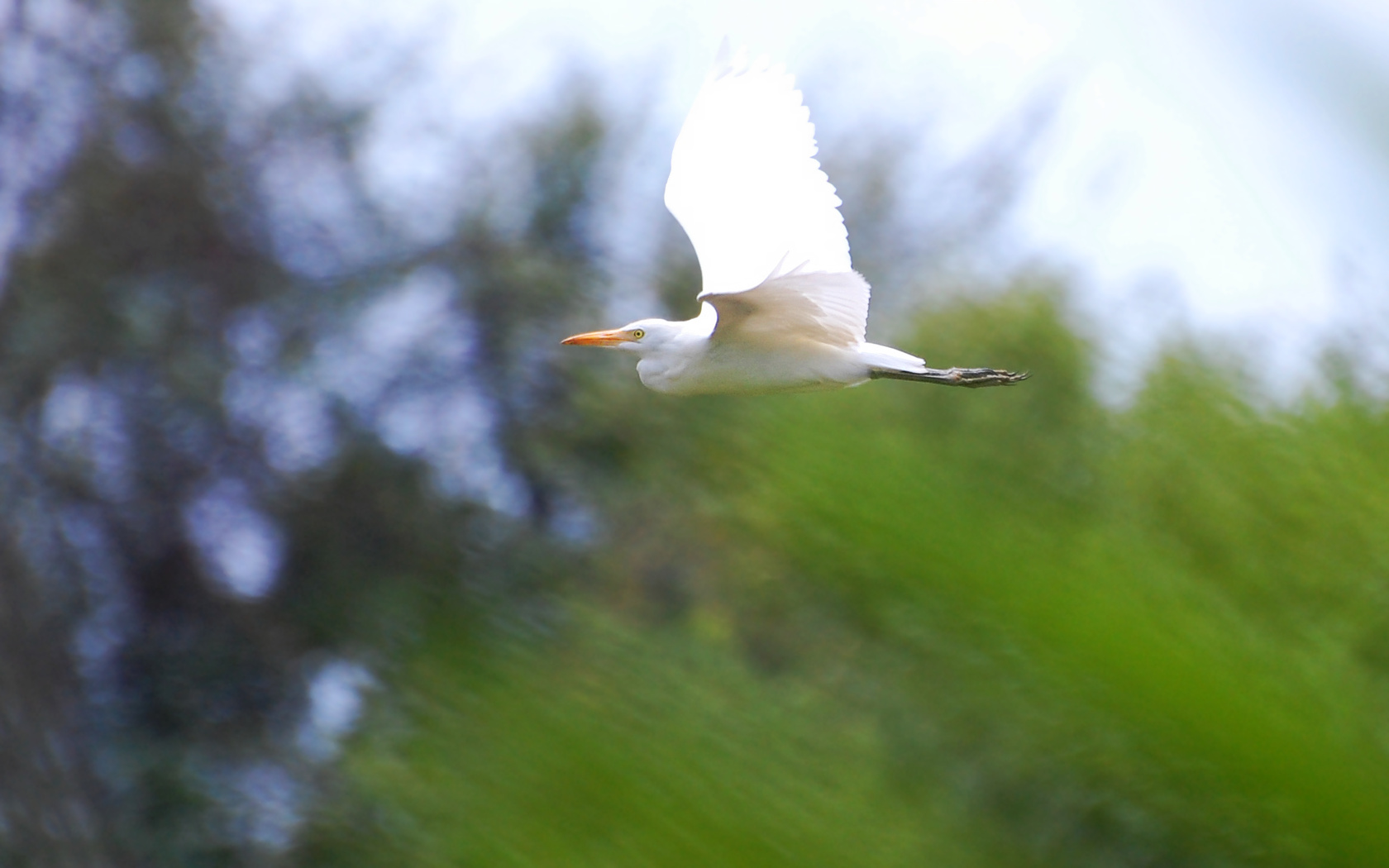
Cattle Egret - wallpaper available
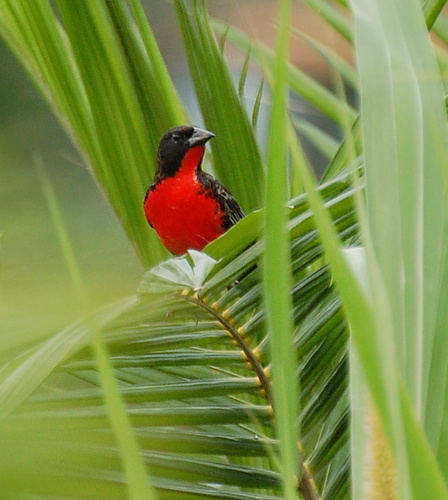
Red-Breasted Blackbird - wallpaper available

A flock of these gorgeous icterids descended on the baby palms one morning while I was out birding. I never saw them after that. Despite the name, they are more closely related to our meadowlarks than to other blackbirds.
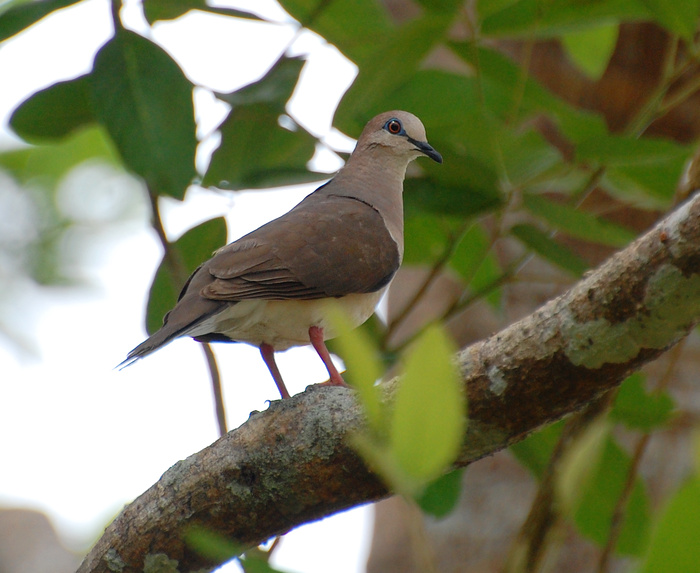
White-Tipped Dove
The blue orbital skin, i.e. the blue around the eye (more visible at high res), is the only reliable way of distinguishing this bird from a Gray-Headed Dove, which has red instead. Interestingly, in areas where Gray-Headed Dove doesn't occur (and thus no confusion could occur), the White-Tipped's orbital skin is red. It's not the only case I've heard where birds seem to have certain features for the sole purpose of telling each other apart. Or maybe they're just helping us bird-watchers out!

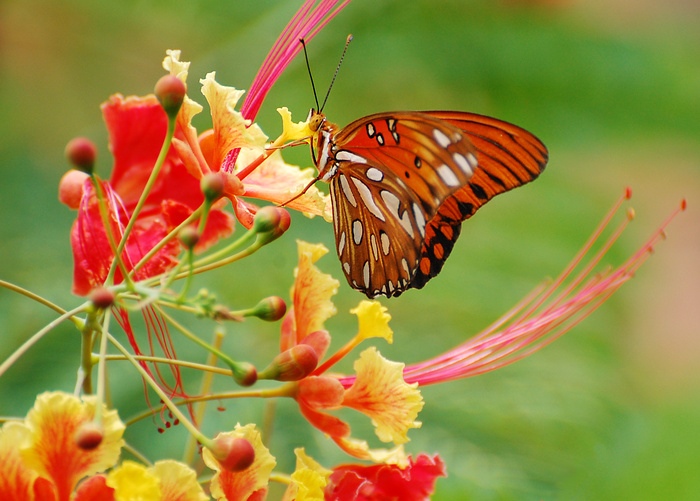
Gulf Fritillary - wallpaper available
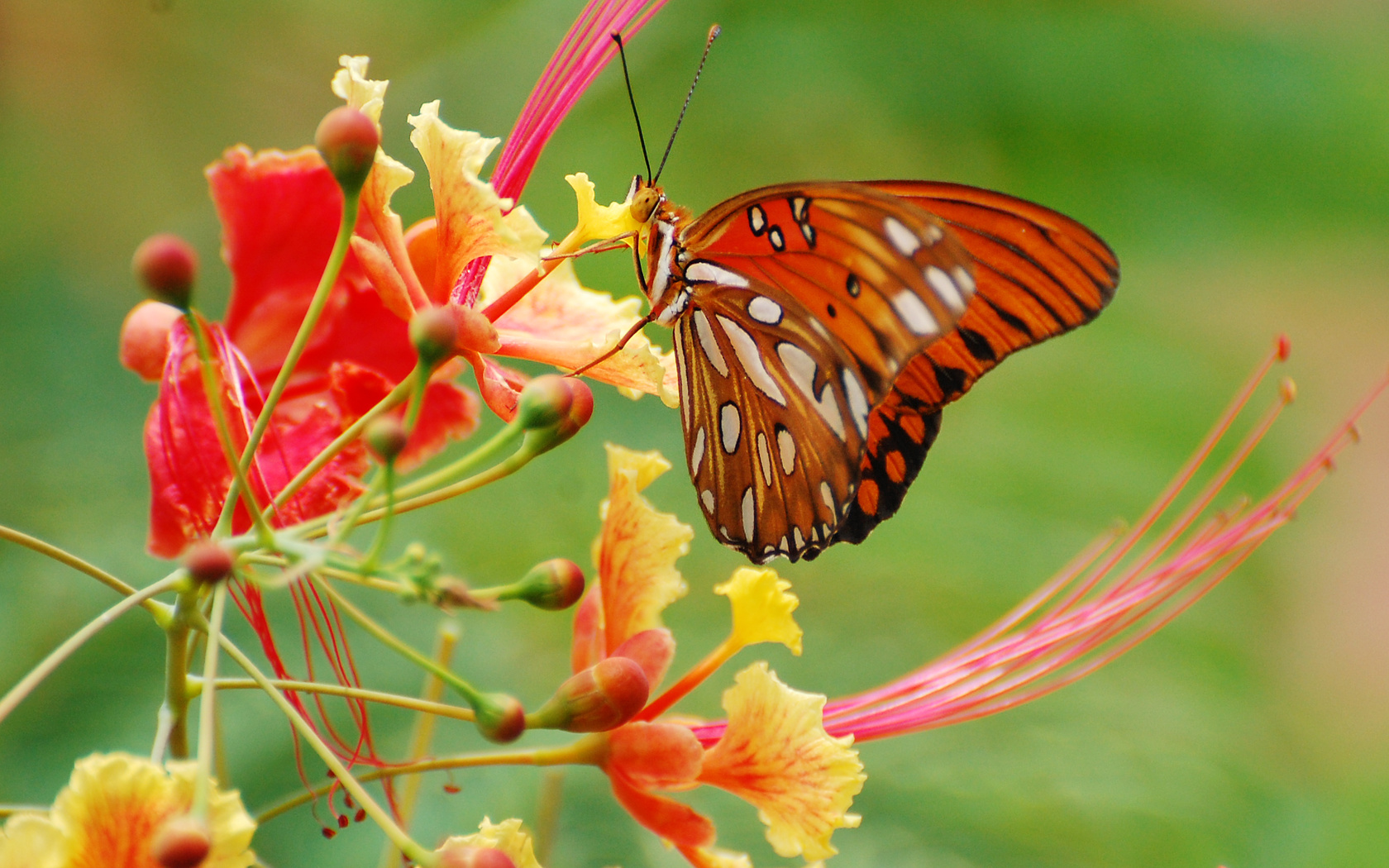
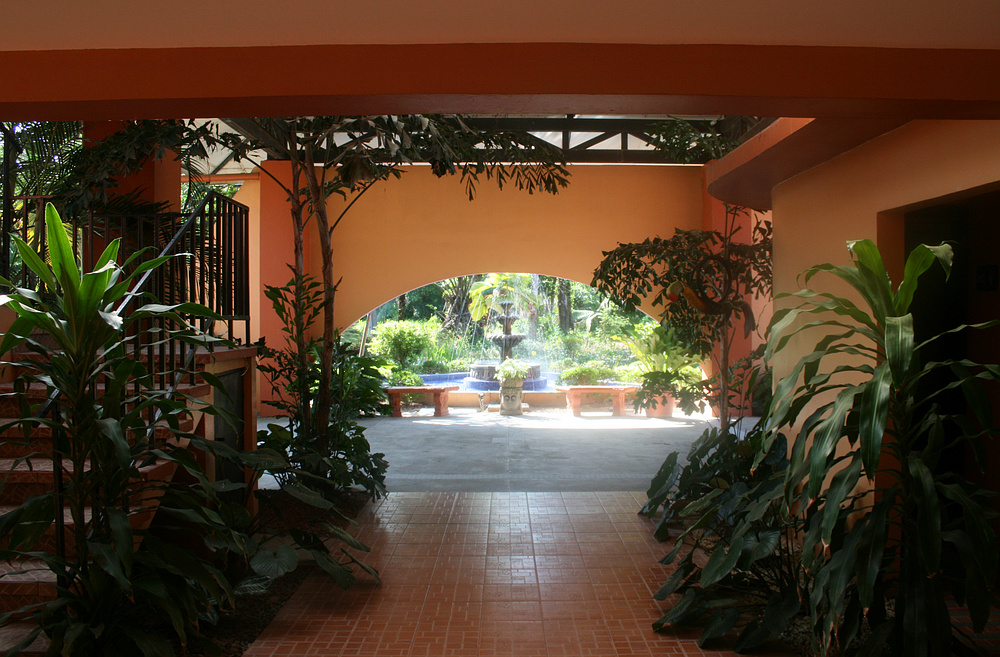
Photo by Michael Britton
The view out to the front garden from our resort. Just looking at this picture makes me nostalgic!
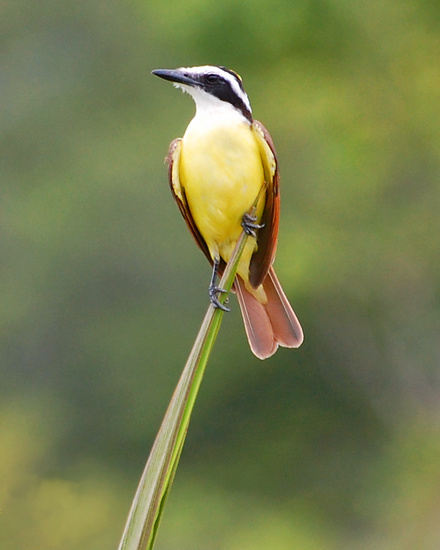
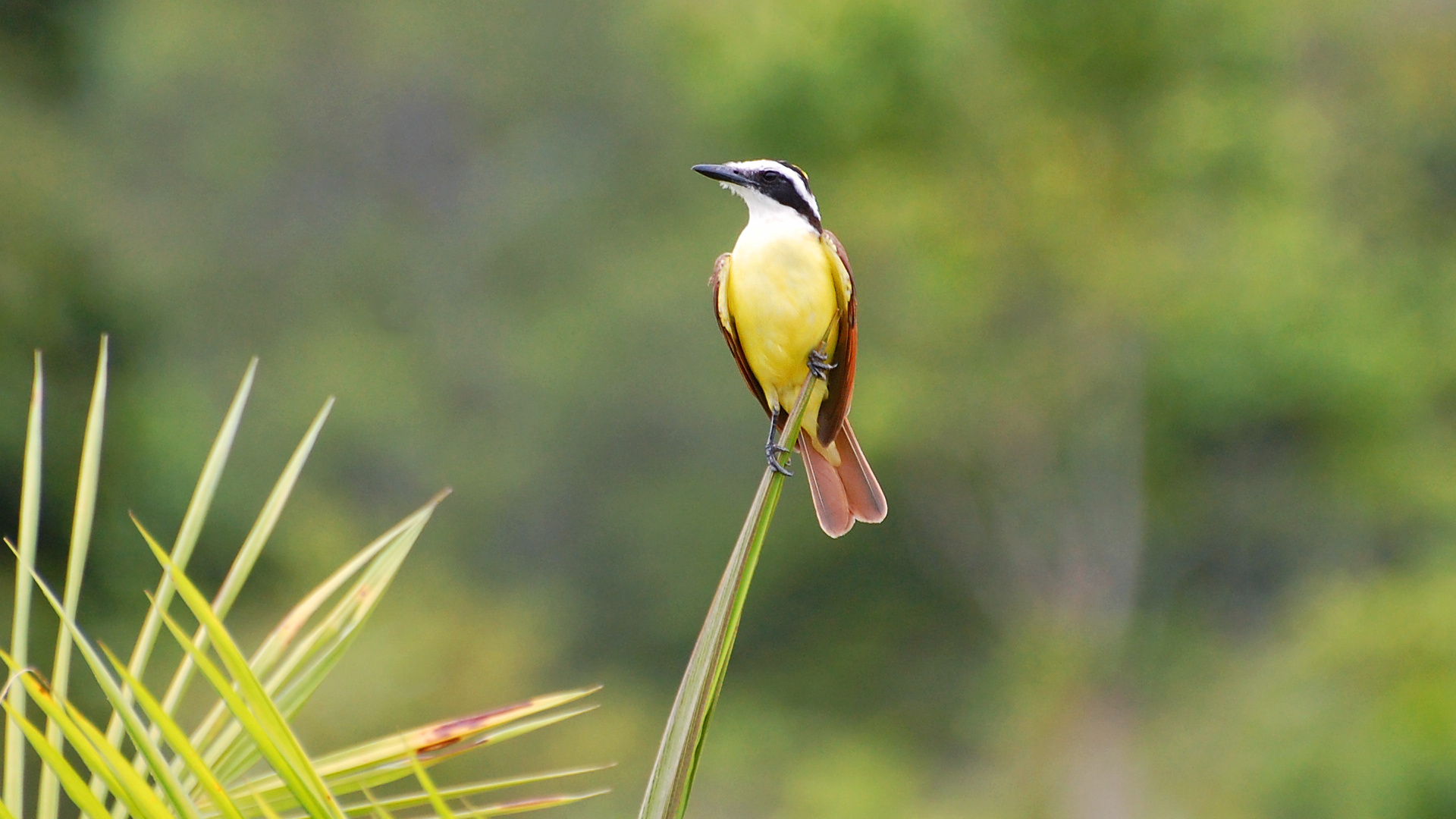
Great Kiskadee - wallpaper available
( More photos and the final triplist )
And now, big damn spider
May 13th, 2014
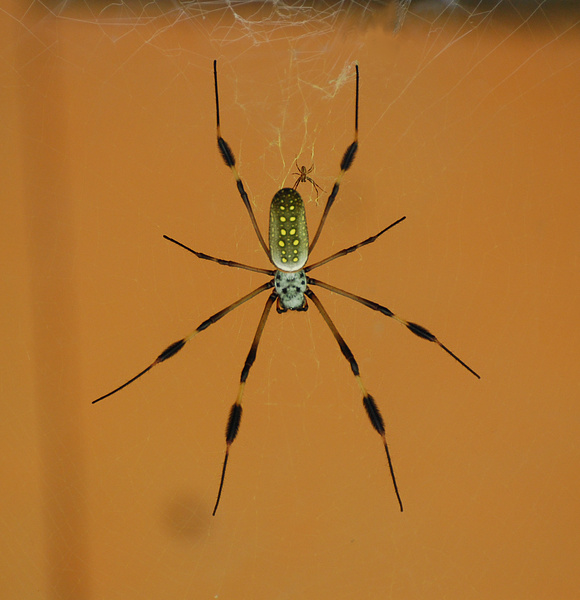
Our guide called her a Banana Spider. She had built her web behind the shelter at the start of the trail.
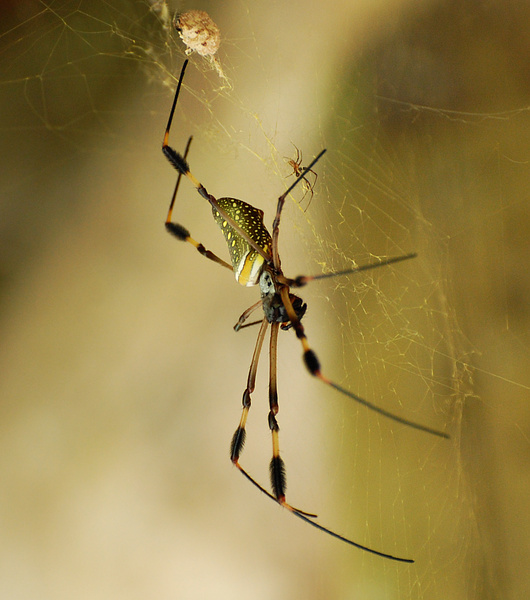
1680x1050 wallpaper

Please understand that this is not the wonders of macro photography making a tiny thing (or small thing, or reasonably-sized thing) look huge. I don't have a macro lens. I have a modest-length telephoto lens, and it filled the frame. I have held a tarantula in my hand before, and I think this spider was bigger than the tarantula.
But there's more. See the tiny spider in the web with her? That's not her baby, or some other, much, much smaller species about to become her dinner. That's her mate. That's what a male Banana Spider looks like.
The Rainmaker Tour
May 11th, 2014
On our last day in Costa Rica we went on a tour of Rainmaker, a privately-owned rainforest, organized by our resort and led by Roger. One of my happy early discoveries at Pueblo Real was that two of the men who worked the front desk, Roger and Oscar, were passionate birders. They were professionals, in fact, who led tours and only worked the desk as a side job. Both were very friendly, spoke excellent English, and were ever willing to share their advice and expertise. Oscar even took us birding for free a few times.
Rainmaker was the most tropical experience I had on this vacation. It was all you imagine when you hear the word "rainforest": giant trees, tarzan vines, sweeping vistas. Alas, I decided early on that it would not be a camera day, not with wavy suspension bridges and mandated walking sticks. Mike did decide to use his camera and got a bunch of scenery shots, of which I have a few favorites. As usual, click on any of these for a higher res version.
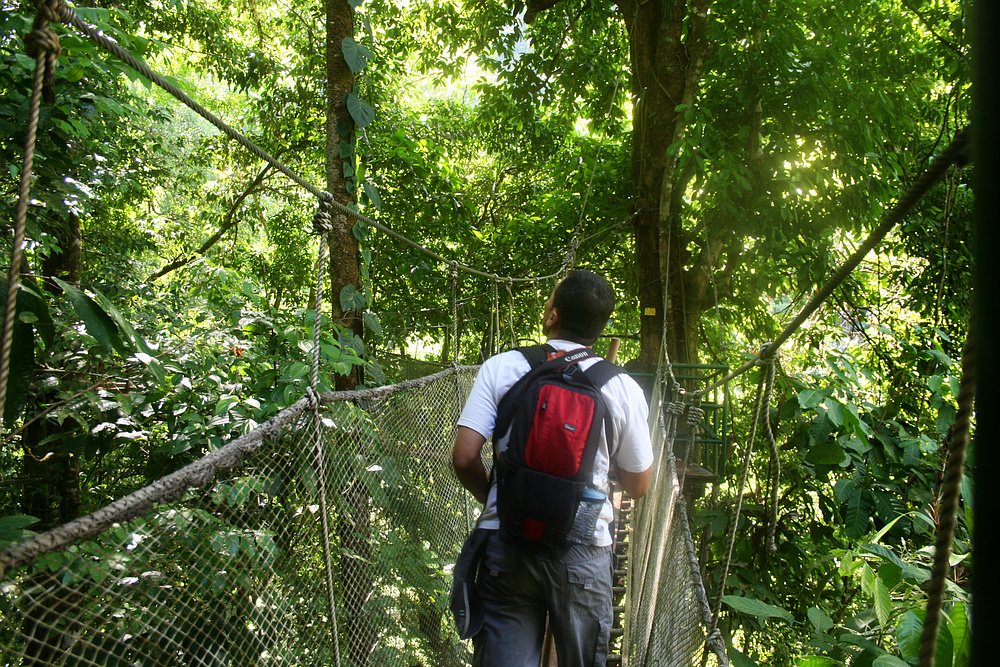
Photo by Michael Britton
Our fearless leader :-)
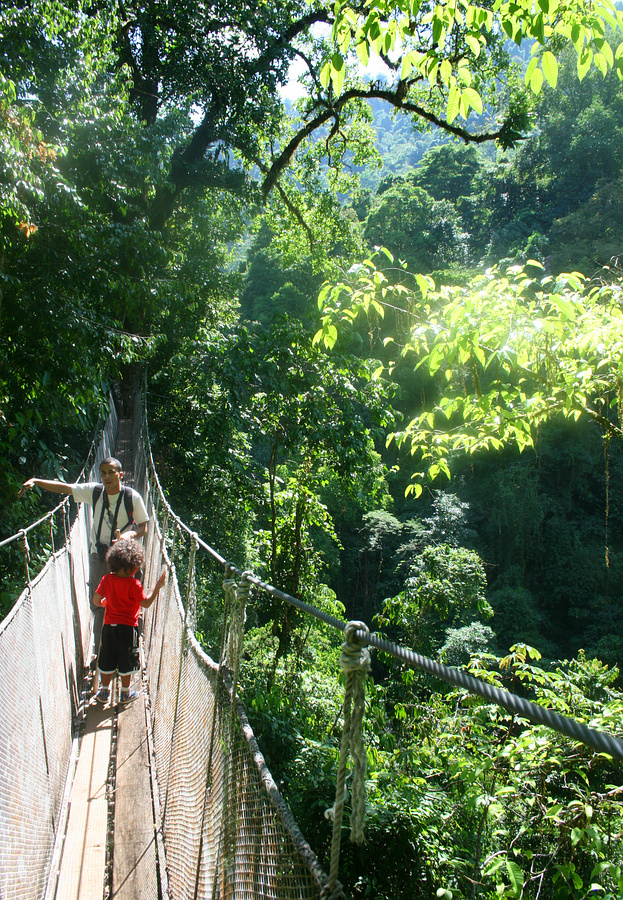
Photo by Michael Britton
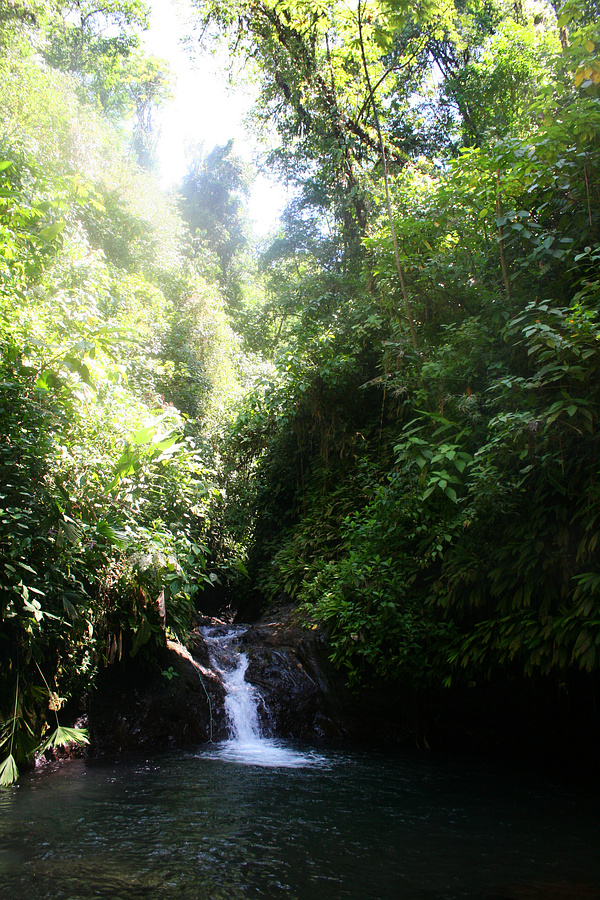
Photo by Michael Britton
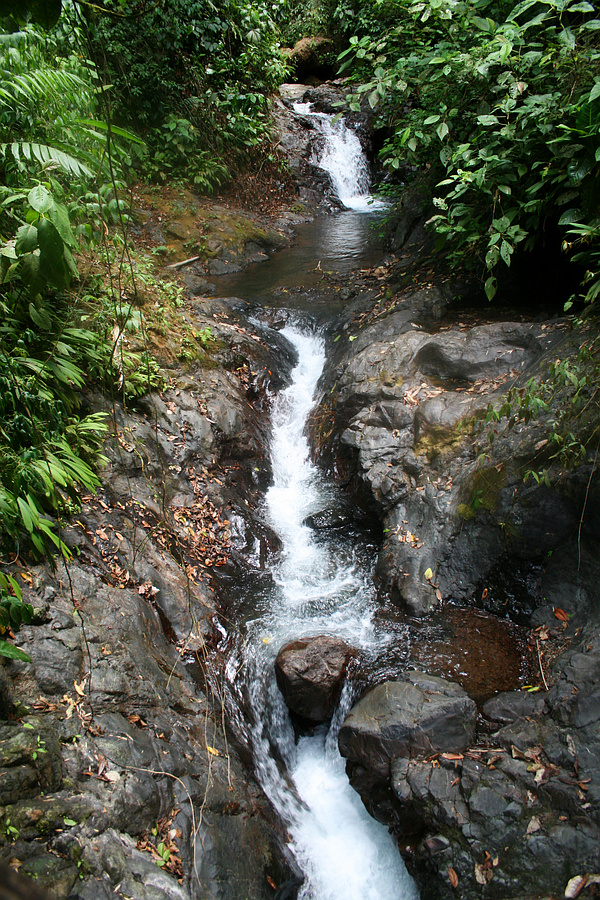
Photo by Michael Britton
As for me, I took photos of just one subject. I'll save those for my next post.
Late morning and it was time for a swim in the pool beneath the waterfall. Except...the birds were calling me. All morning I'd longed to see more of them, but the noise and activity of the two children in the group kept them at bay. So when Roger offered to take me around birding while the rest of the group swam, the waterfall, pristine and inviting though it was, had to be passed up. "Unless you'd like to swim," I said.
Roger replied, and I quote, "pff."
So we went around a bit, not getting too far from the group, and were rewarded with excellent views of a Buff-Rumped Warbler hopping from rock to rock in the stream below the falls. Buff-Rumpeds are "resident" warblers in Costa Rica: they actually live out their lives in the tropics instead of flying to North America to breed. They're always found near flowing water, with a loud, ringing song that can be heard over the roar of a waterfall. I found their habits very similar to those of our own Louisiana Waterthrush (a rare warbler in this area, but it's been known to nest at Lauriault Falls.) Waterthrushes are some of my favorite birds, and I loved Buff-Rumped Warblers as well.
The "good bird" of the day was a Stub-Tailed Spadebill. I am Roger's backup for his claim of having seen one (having seen it also, and pegged it as such independently), since it was believed to have been extirpated from the region!
And the floodgates open
May 9th, 2014
We interrupt your regularly scheduled Costa Rica photo albums to announce that warblers have arrived in Ottawa. Oh. my. god. have they arrived.
1680x1050 wallpaper
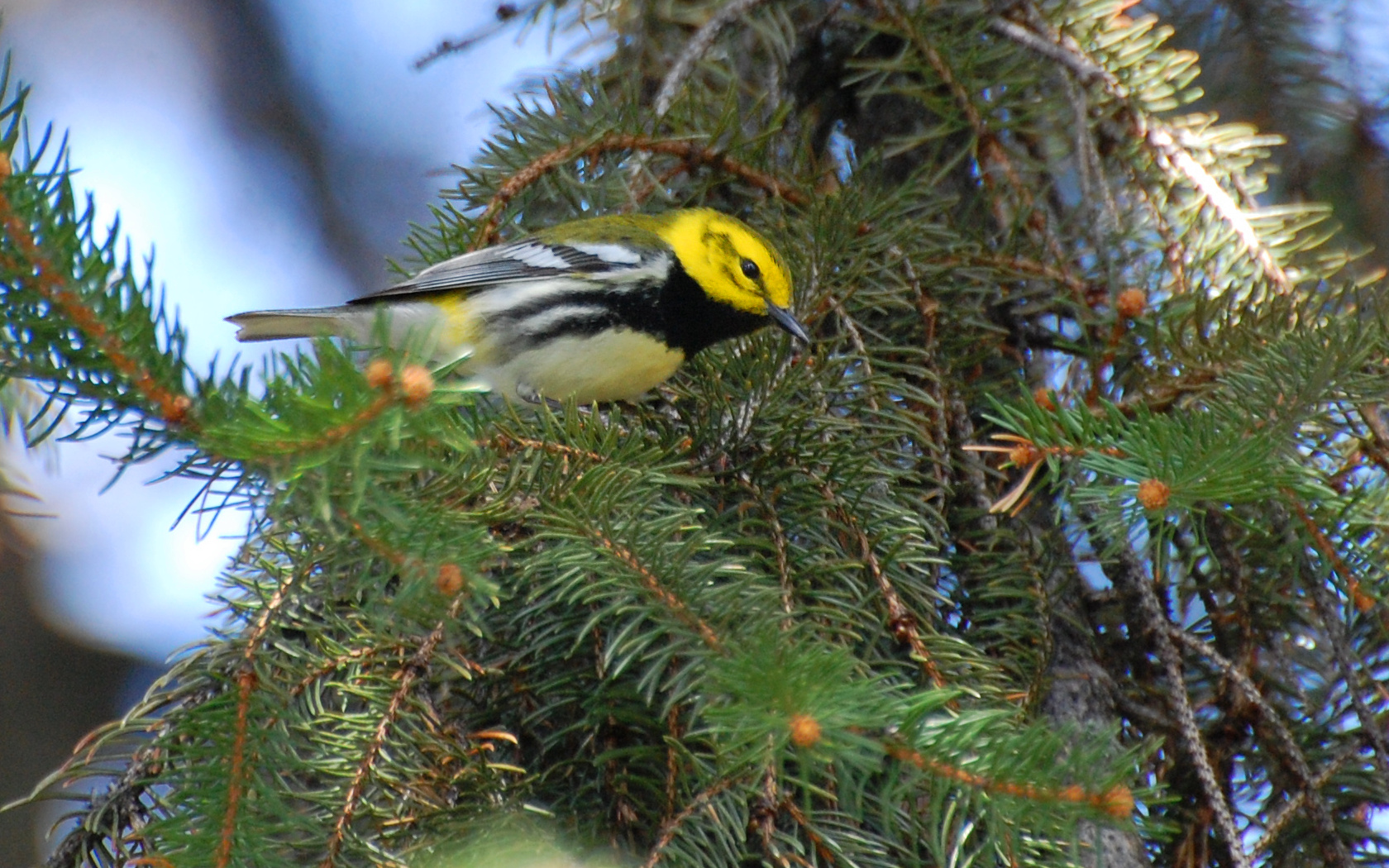
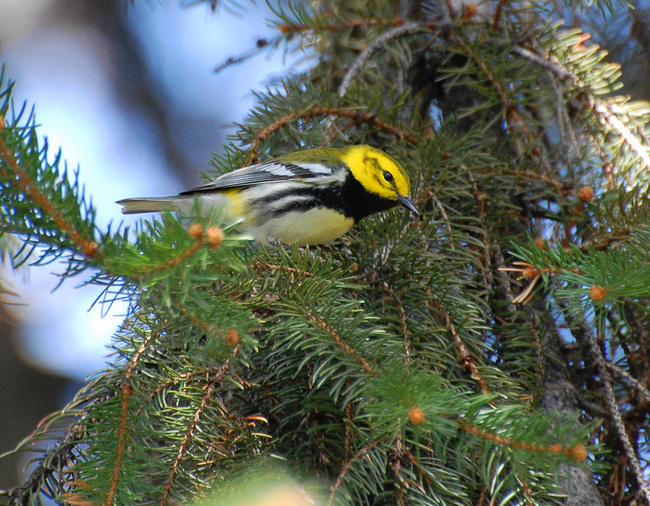
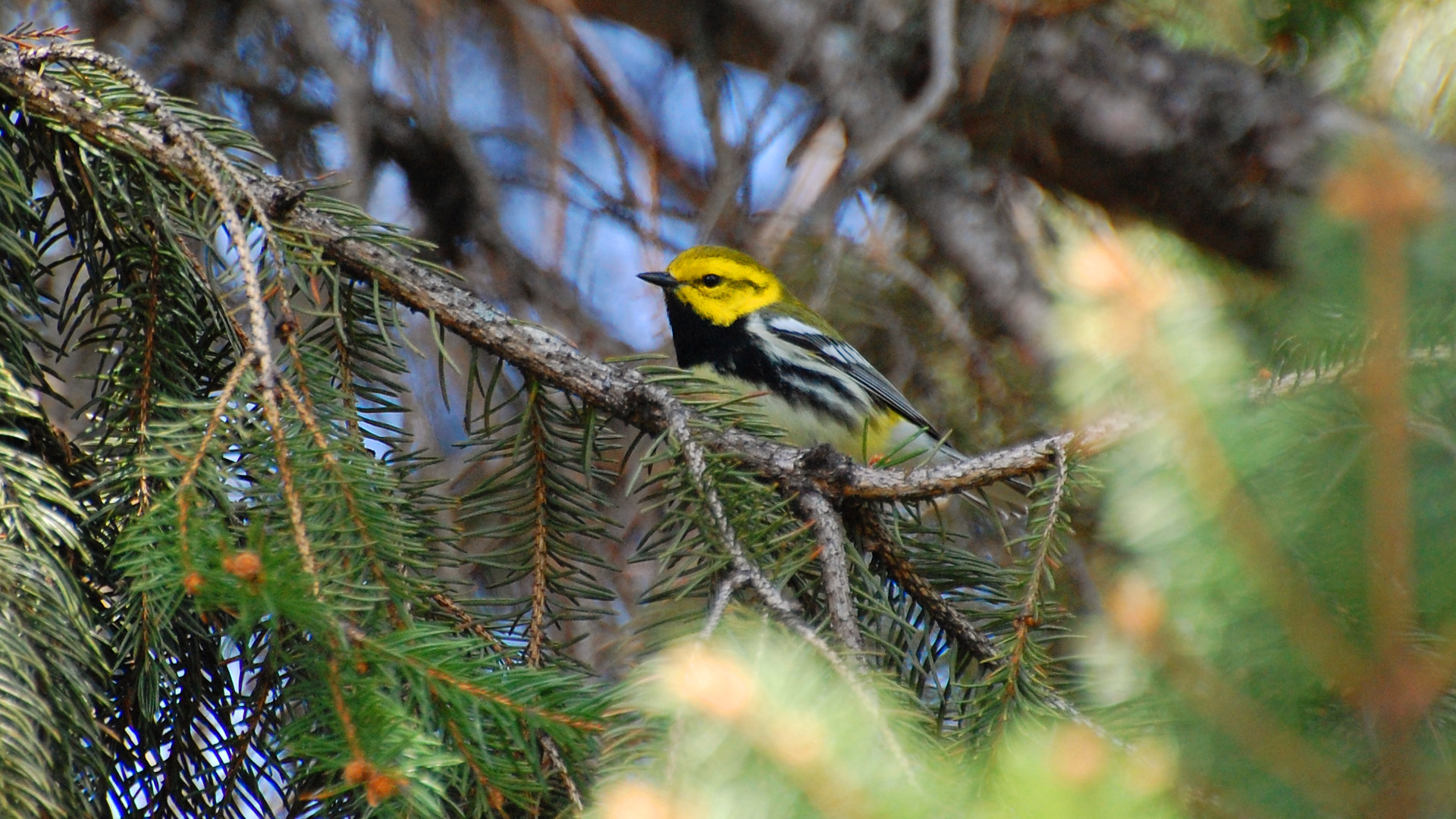
This Black-Throated Green Warbler was practically begging to be photographed. As the guy next to me said, "he certainly seems to think he's important!" These beauties actually nest in our area (Stony Swamp, South March Highlands, Gatineau), but it's hard to see them on their breeding grounds. They tend to stay high up in the trees.
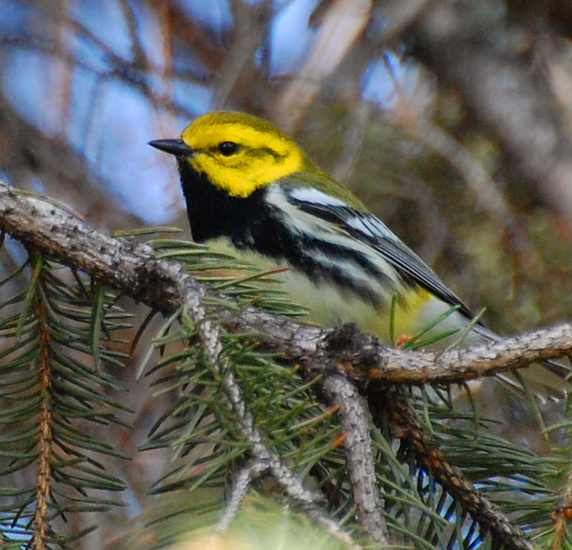
1680x1050 wallpaper
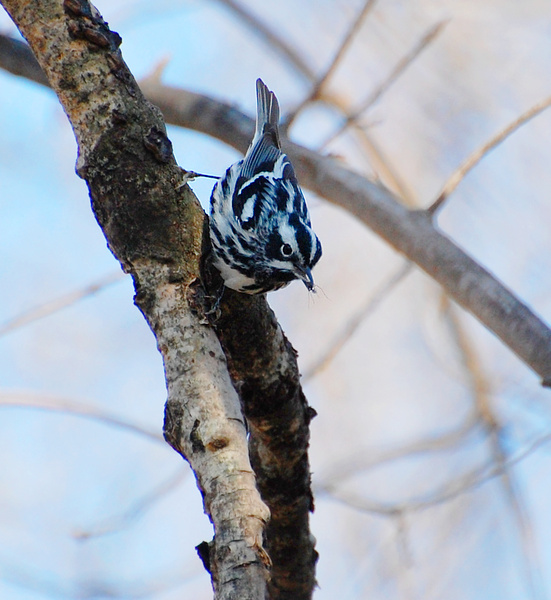
Black-and-White Warbler
Remember this one? I like to fondly imagine that it's the very same Black-and-White Warbler I saw splashing in a creek two months ago in a Costa Rica rainforest.
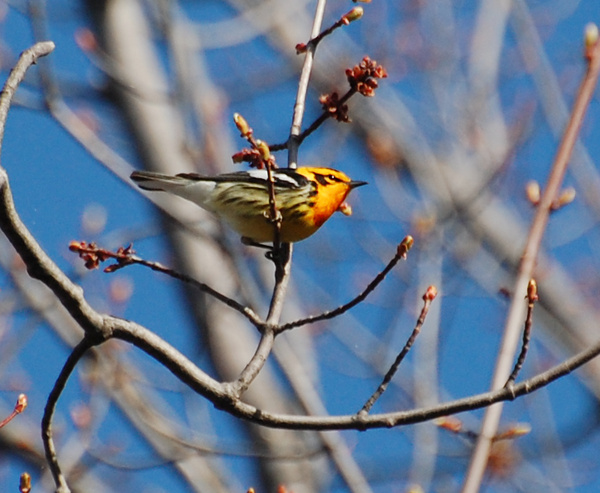
Blackburnian Warbler
My favorite bird in all North America, photographed for the first time. (Not photographed terribly well, I'm afraid, but it's a start!)
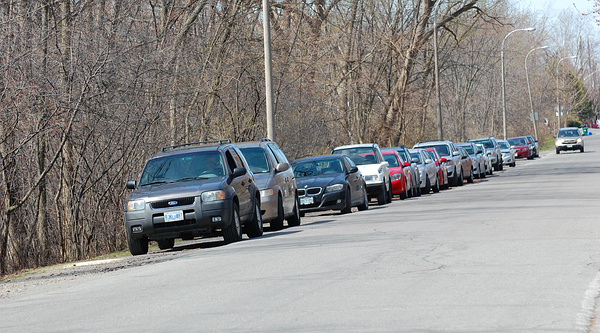
This is what the cars look like at Mud Lake, on a weekday morning, when the spring warblers finally get here:
Carara National Park (part 4)
May 6th, 2014
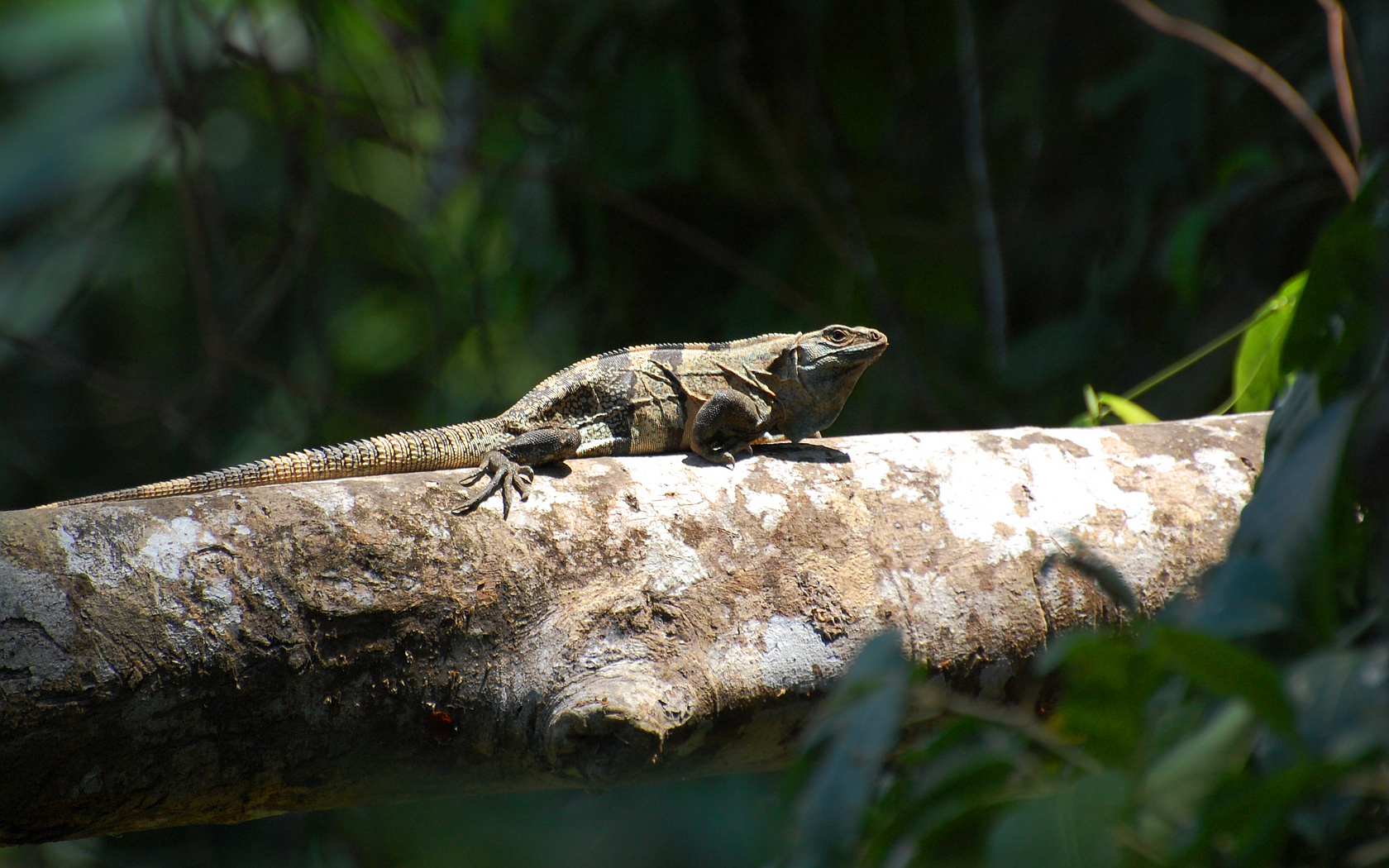
I wasn't above photographing the occasional reptile on a birding tour, either :-)
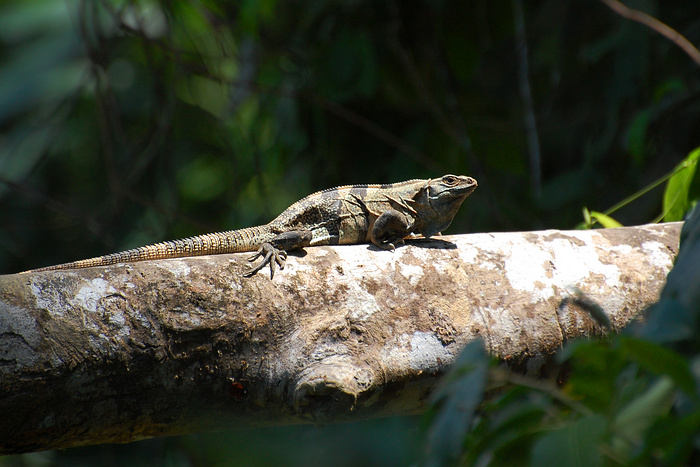
1680x1050 wallpaper
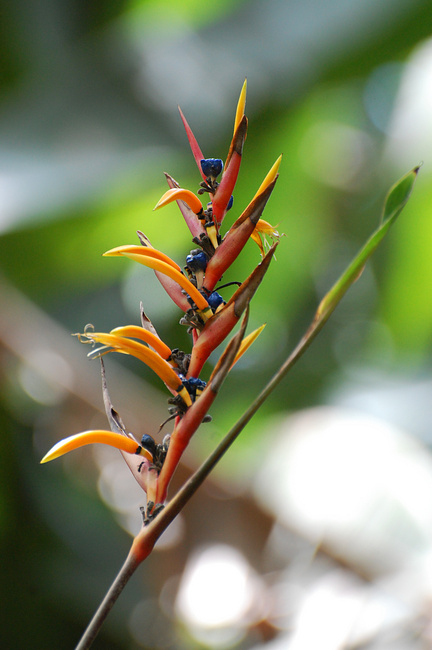
Nor flowers:
Familiar Turkey Vultures and Black Vultures were ubiquitous in Costa Rica (even on the beach!), but I saw only two King Vultures, both thanks to Johan. The first, my lifer, was in Esquipulas, and was too far away for even a bad picture. Johan spotted this one soaring soon after we came out into the open at the lagoon.
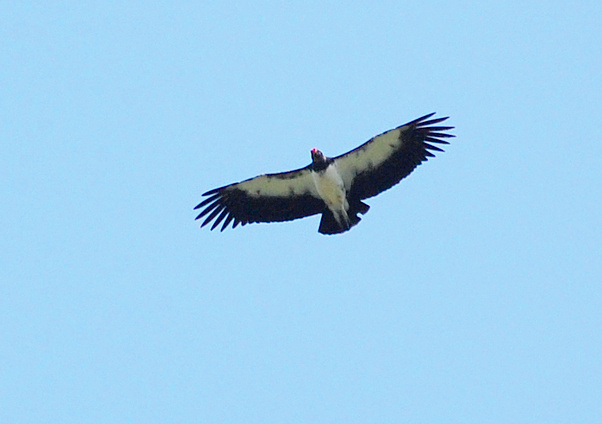
Here's what a King Vulture looks like up close. It's said they're called kings because when they descend to a carcass, other vultures make way. You can kinda see why.

Late in the day, Johan took us to a small creek which is known as a favorite evening bathing spot for a variety of birds, and we stayed there until sunset. This ended up being not only a high point in the Carara trip, but one of the high points of my whole vacation. Photographing it was difficult. The lighting was poor, and my camera wanted tons of exposure time to compensate; I could not possibly hold it steady enough to expose for that length of time without blur. Of course, disturbing the birds with flash was out of the question. I considered fiddling with the ISO setting, and our guide graciously offered to lend me his tripod, but in the end, I decided to just sit and enjoy.
A Red-Capped Manakin was the first to make an appearance. (Red-Capped Manakins, on account of their particular lek dance routine, are called "Michael Jackson birds." They moonwalk. (No, seriously--if you only ever click on one link in my blog, click on this one. You won't regret it.)) Then another, and another still. While one of them was splashing in the water, a Blue-Crowned Manakin perched right over his head--a visceral "wow" moment for both me and Michael. A Black-and-White Warbler (a wintering bird from North America) made an appearance, followed by a Sulphur-Rumped Flycatcher. A Long-Billed Hermit (at six inches, a comparatively enormous hummingbird) zipped in, dipped his tail, and zipped out. A late arrival was a nondescript brown bird called a Thrushlike Schiffornis, which our guide proclaimed to be the best (i.e. rarest) bird of the trip.
The most my camera (and some digital sharpening) could do:
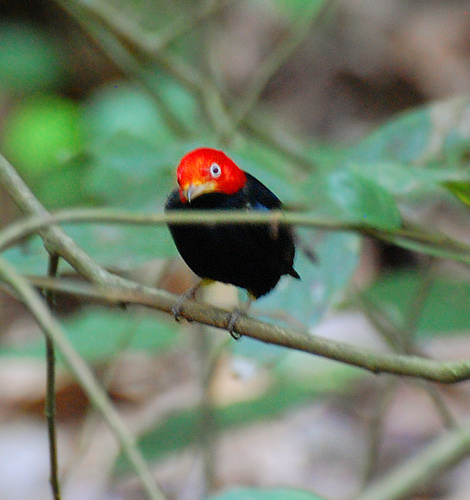
Red-Capped Manakin
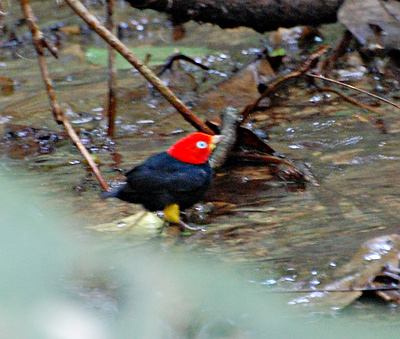
Those things that look like yellow leg warmers are part of the bird. He shows them off when lekking.
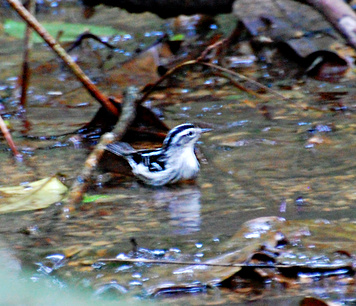
Black-and-White Warbler
When this incredible show was over, alas, Carara was over, and we hurried back down the trail before night set in, accompanied by the lion-like roars of a troop of Howler Monkeys.
Carara National Park (part 3)
May 3rd, 2014
Once we reached the lagoon, I crept along the edge angling for a good photo of the shorebirds and herons. The harsh midday sun made things difficult--as did the wariness of my subjects! This pair of Black-Necked Stilts regarded me sternly, while the young Jacana seemed to wonder what all the fuss was about.
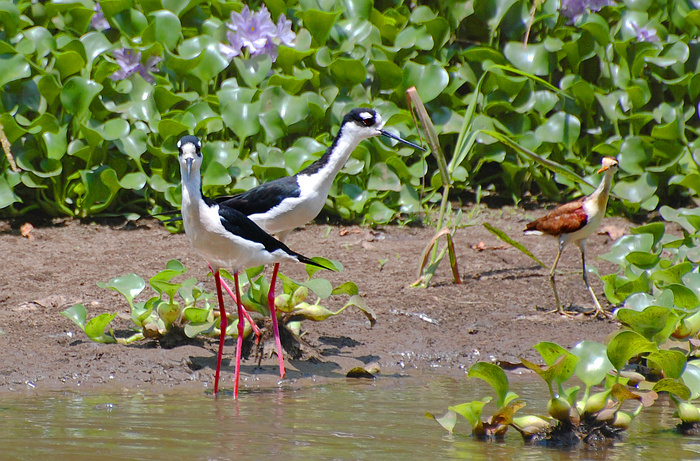
1680x1050 wallpaper
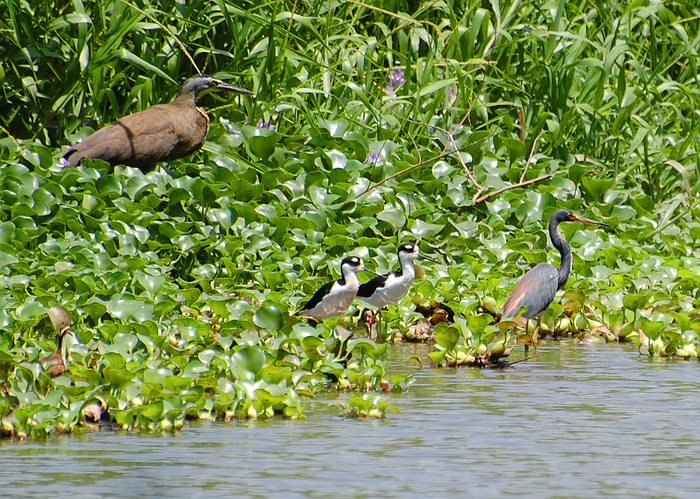
Left to right: Bare-Throated Tiger Heron, Black-Necked Stilts, Tricolored Heron. The young jacana is hiding in here too. Look near a brown leaf to find him.
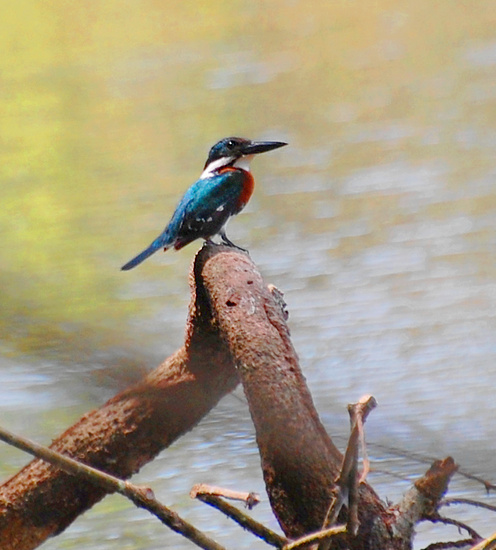
Green Kingfishers were common, as they seemed to be in just about any wetland in Costa Rica. This one looked rather regal in the bright sun.
At the end of the lagoon trail lay a Boat-Billed Heron nesting colony. I'd seen Boat-Billed Herons in my field guide before the trip, and thought they looked a lot like our local Night Herons (to whom they're related.) In person, they looked nothing like Night Herons. They looked like the strangest birds I'd ever seen: like giant-eyed, bulbous-billed muppets. The juveniles were, frankly, ugly, but it was an ugliness you had to love!
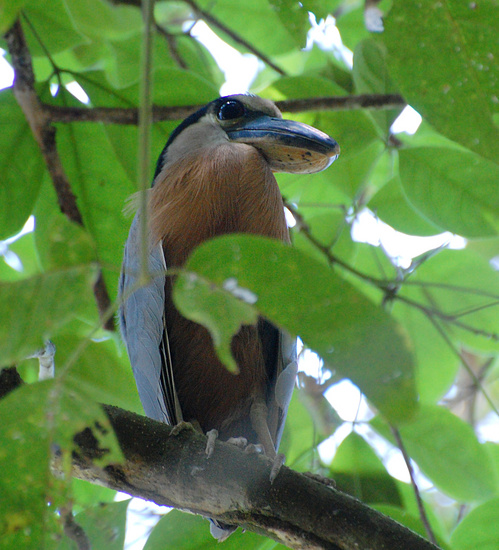
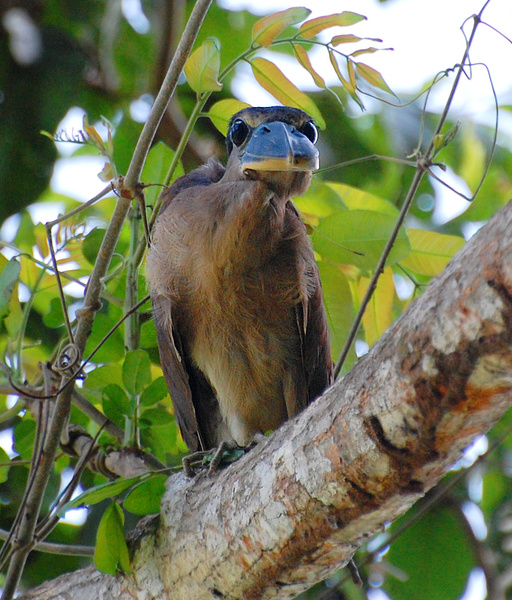
The adults go for a more debonair look, taking on a slightly less bulbous bill and a wavy hairdo.
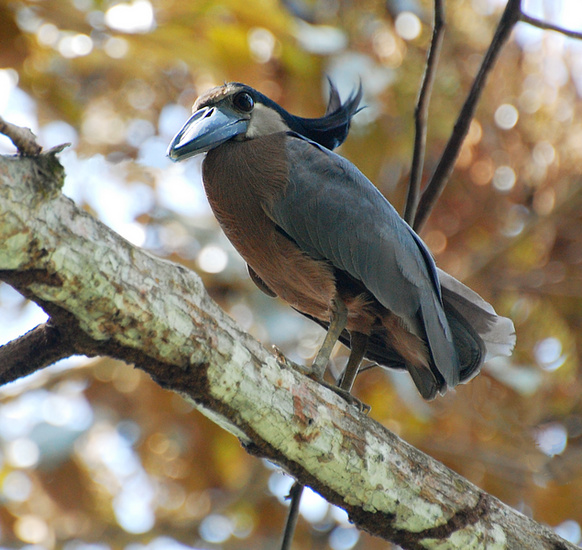
Not a photomanip, I swear to god. They really look like that.
They're nocturnal herons, thus the huge eyes. The bill is an adaptation to their diet and way of feeding. While most herons spear fish using their long, pointed bills, Boat-Billed Herons just scoop them up out of the mud, along with small crustaceans and aquatic insects.
(Continued in next post)
Carara National Park (part 2)
May 1st, 2014
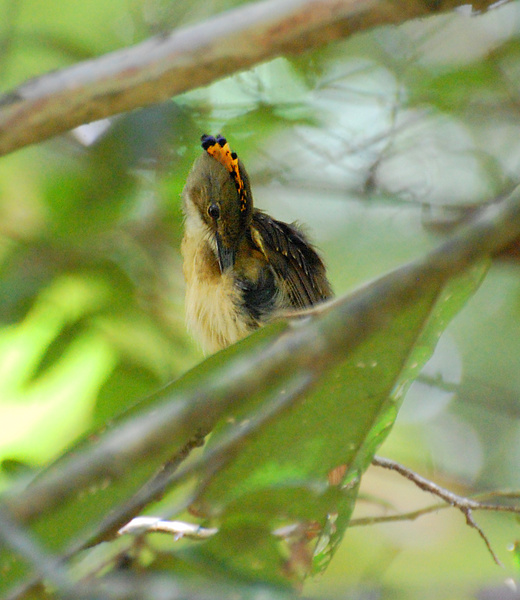
There are a lot of showy birds in the rainforest. But the showiness of the Royal Flycatcher is sneaky: an exuberant multicolored peacock crest that stays hidden 99% of the time, folded up like an Asian fan into the back of the head.
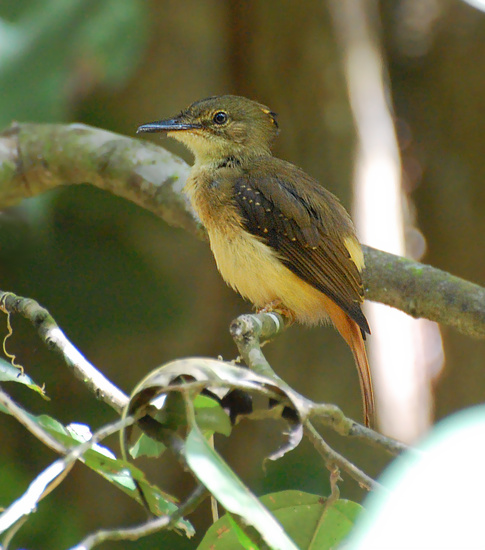
When it does unfurl, it's very much a blink-or-you-miss-it affair. The easiest way to get a good look is like this: take the bird in hand. Apparently, as discovered by bird banders and researchers, the experience of being held is startling enough to provoke a full-on display. Those of us for whom that is not an option must content ourselves with brief unphotographable glimpses, or with the fraction of the crest that sticks out when the bird preens.
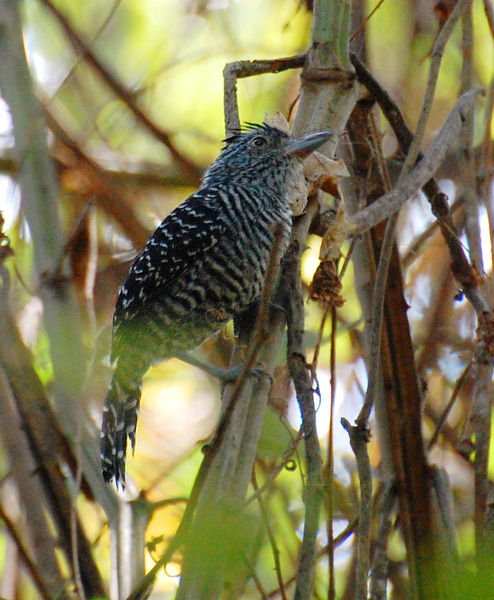
Another of the many army-ant-followers, Barred Antshrike was on my wishlist due to its striking black-and-white plumage. I saw only this one, skulking in a dense thicket. (Like so many of my successful wishlisters, I have Johan's eagle eyes to thank for it.)
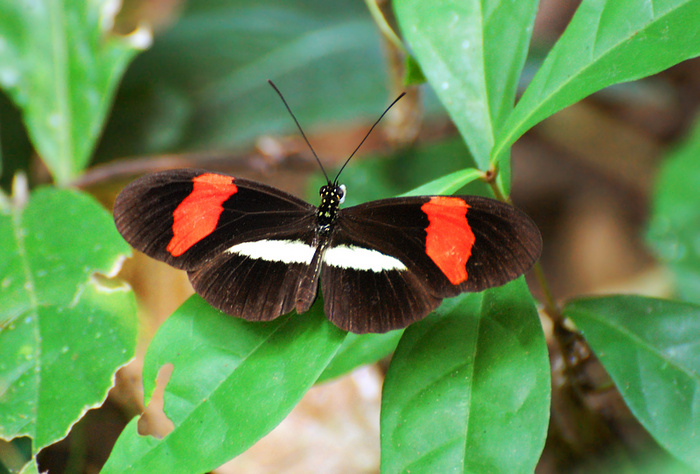
I wasn't above photographing the occasional butterfly on a bird-watching tour! This one's a Red Postman, I think.
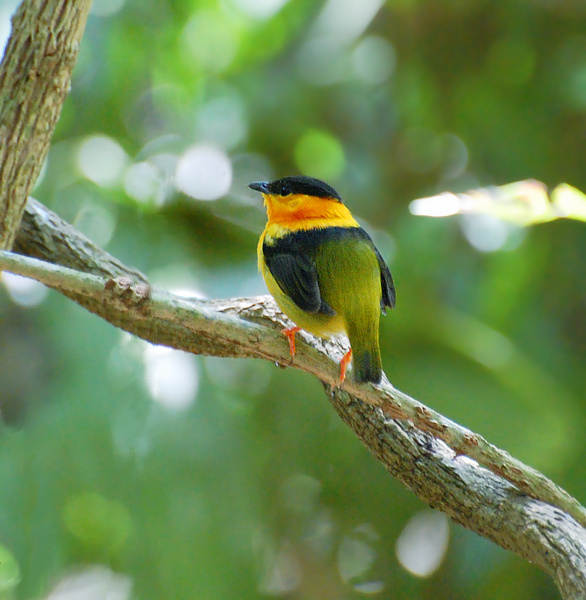
Orange-Collared Manakin
Just can't get enough of him :-)
(Continued in next post)
|